The Story of Palazzo Sapori
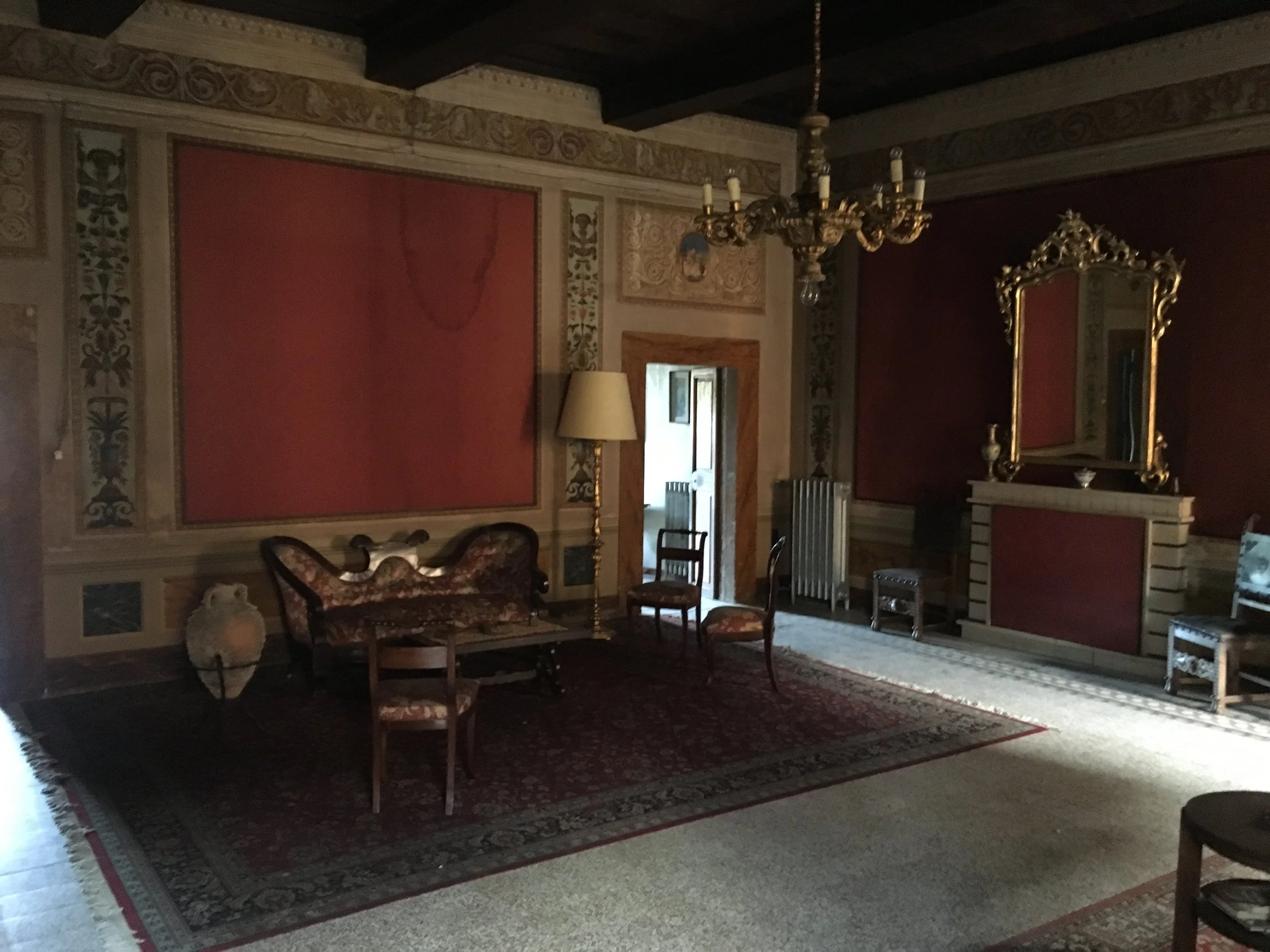
Lien and I had been dating for four months when we arrived in Soriano nel Cimino in July 2016.
Neither of us had heard of it.
We had planned to use my Diamond Resorts points for a trip to Europe. France and Spain were our first choices, but neither was available. Diamond had one property in Italy, in a medieval village north of Rome that seemed reasonably close to the places we wanted to visit.
So we went.
For the first week, we treated Soriano as a place to sleep. We drove to Rome, Florence, Pisa, Cinque Terre and through Tuscany, returning each evening increasingly exhausted. Eventually Lien announced that she was done touring. She wanted to stay in Soriano and see the village.
“Okay,” I said. “What are we going to do after 45 minutes?”
She asked what I had in mind.
“We could look at real estate.”
A few days later, on August 2, we walked into Agenzia Fiorentini.
We didn't speak Italian. The real-estate agent working in the office didn't speak English. Google Translate got us far enough for her to tell us that her daughter did and could join us in fifteen minutes.
That was enough.
The first apartment they showed us was what would eventually become Palazzo Sapori.
We couldn't get through the front door. A crack in the wall above it had caused the door to jam, so we entered through the kitchen.
The apartment had been empty for years, although it didn't feel empty.
Clothes remained in the dressers. Cigarettes sat extinguished in ashtrays. Furniture and china were still in place. The shutters were closed, and the rooms were dark. The air smelled like a fireplace after the embers had gone cold.
Lien thought it was haunted.
I thought it was magnificent.
Beyond the neglect, the apartment still had a certain confidence about it. The ceilings were fourteen feet high. Painted walls and old tile floors survived. The rooms gathered around a grand central salon, and through the windows were the main street, the piazza and, above it all, the castle.
There were also cracks in the walls and a bedroom floor that had sunk noticeably in the middle.
I had no idea whether the building was sound, whether we could buy property in Italy, whether a bank would lend to us, or what restoring a place like this would involve.
I told Lien we would keep moving forward until we encountered an obstacle we couldn't overcome.
Before leaving Soriano, we hired a geometra to tell us whether the building was structurally sound and what restoring it would entail.
I also tried to open a bank account so we could begin paying him. The bank manager couldn't figure out how to open one for an American nonresident, and we were leaving the following morning.
Our interpreter's thirteen-year-old son, Dane, happened to be with us. I asked the manager if we could leave him our remaining cash from the trip and have him deposit the funds into the account once it was approved.
He declined.
Then I suggested we convert the cash into a cashier's check payable to me and let Dane hold it until the account could be opened.
That evening, during our final dinner at Rottezzia, the owner of the restaurant, Egisto, approached our table.
“The boy is looking for you,” he said.
Dane needed additional information for the bank, such as Social Security numbers and dates of birth.
We asked how he had known where we were eating.
He hadn't. He had been going from restaurant to restaurant asking if anyone had seen the Americans.
The bank account was never opened.
Back in California, we tried to contact Dane's mother to get the check back. Our emails went unanswered. Her telephone number stopped working.
Months passed.
Lien was certain I had given our money to a thirteen-year-old stranger in an Italian village and would never see it again.
The following year, we returned to Soriano after visiting Barcelona and the Amalfi Coast. We walked into the real-estate office and asked Marco whether Dane's mother, Peta, still lived there.
He seemed confused by the question.
Of course she did.
He called her. Fifteen minutes later, she walked through the door with our check.
She had changed her phone number and email address and lost our contact information.
Lien saw a narrowly avoided disaster.
I saw it as a good omen.
Obstacle overcome. We continued moving forward.
It took nearly two years before Palazzo Sapori was ours.
When I returned to Soriano in June 2018 to complete the purchase, the apartment was much as we had first seen it. Before anything new could happen, I had to begin deciding what should remain.
That turned out to be harder than deciding what to throw away.
The belongings weren't ours, but they didn't feel entirely disposable either. We kept the china and much of the furniture. We found fur coats and old Italian Air Force uniforms. Among the papers was a century-old photograph, certificate and medal belonging to Ernesto Caliento, an ancestor who had served in the Guardia di Finanza. They now hang in the stairwell leading to the cantina.
One afternoon, while cleaning out the old office, we found an envelope of fragile papers.
Lien wanted to throw everything away.
I wanted to inspect it first, to see whether anything was worth keeping.
Inside were recipes written in graphite and red ink, in the careful handwriting of another generation. One was for Dolce di Ricotta, a regional, rustic relative of tiramisu made with Mistra.
I brought it back to California, had it professionally scanned and enlarged onto canvas.
It hangs in the kitchen today.
By then, we had begun learning about the people whose things we were sorting through. The Sapori family had owned the apartment for decades. The last owners—a doctor and his wife, Maria Sapori—were still remembered fondly in town.
We considered several names for the property. We wanted to honor the history of the previous owners and considered calling it Casa Caliento Sapori. But the contractors working on it already had another name.
On the architectural drawings, it was simply Palazzo Sapori.
We kept the name.
The same instinct gradually began guiding the renovation.
We wanted modern plumbing, heating and electrical systems, but we weren't interested in making the apartment feel new. Nor did we want to create a theatrical version of the eighteenth century.
The question became less about restoration than about continuity: What might this place have become if each generation had changed only what it needed to change?
Spartaco helped us answer that question.
He was our interior designer, although that description understates his importance to Palazzo Sapori. He approached the apartment with a passion that matched my own and an instinct for how materials, colors and objects belonged together. More often than not, we found ourselves on the same page.
He also understood something that became increasingly important to me: authenticity did not require extravagance. It required honesty.
When an authentic material could be used, Spartaco generally preferred it to an imitation. Old furniture was worth restoring. Wood should feel like wood. Stone should be stone. The building didn't need to disguise what it was.
There were places where we disagreed, of course. That was inevitable among people who cared about the outcome. But those disagreements tended to refine the idea rather than change its direction.
And sometimes the apartment settled the question for us.
The old kitchen fireplace had been altered sometime in its history. During construction, the workers found its original peperino stone surround in the basement.
It was still blackened with soot.
Peperino is a local volcanic stone. It isn't precious. In an earlier era, someone with more money might have chosen marble. But peperino appeared throughout the apartment, including in old doorframes that later owners had plastered and painted to resemble something grander.
The stone was returned to the fireplace.
The soot stayed.
After that, I became less interested in making old things look new.
When a contractor later left the print of his hand on the copper kitchen flue during installation, I considered polishing it away. Instead, I left it—evidence of someone's contribution to the apartment's rebirth.
By February 2020, when Lien and I returned to Soriano to make some of the final decisions, Spartaco had become the person I relied on most to translate an idea into something tangible. Years of decisions had created a shorthand between us. I might begin with an impression of how a room should feel, and he understood how to get there.
That didn't mean we always agreed.
One of the remaining debates involved the kitchen sink.
Lien wanted stainless steel. Spartaco, the contractors and I wanted one carved from a solid block of marble.
Neither side was inclined to surrender.
Lien had already vetoed a built-in espresso machine, leaving some room in the budget, so I proposed a coin toss.
The contractors gathered around.
I called heads for marble. Lien called tails for stainless steel.
Our geometra tossed the coin, caught it, turned his hand over and revealed heads.
Everyone except Lien cheered.
Lien immediately protested that turning his hand over had also turned over the coin.
She was informed, quite explicitly, that this was how it was done in Italy.
The marble sink went in.
It is tempting, looking at Palazzo Sapori now, to imagine there was a master plan for all of this.
There wasn't.
There was an idea of what the apartment could be, followed by hundreds of decisions made over several years. Some were ours. Some came from Spartaco. Others came from the building itself when a wall was opened or an old piece of stone appeared somewhere no one expected to find it.
Over time, those decisions began to speak the same language.
We flew home on February 22.
Within days, Italy began shutting down.
For a while, Palazzo Sapori existed for us almost entirely through a screen.
Work stopped and then resumed slowly. Photographs arrived through WhatsApp. Plans came by email. Spartaco and I talked at odd hours about details that probably seemed absurd in the middle of a global pandemic.
But there was something reassuring about those conversations.
By then, I trusted him. More importantly, I knew he cared about the result for reasons beyond simply completing another project. Even from thousands of miles away, there was always another material to consider, another photograph to study, another detail we could get right.
When the work neared completion, I realized I would miss those conversations.
We returned in 2021 after more than a year away.
The apartment wasn't quite finished. Furniture was still arriving and there were empty spaces where things would eventually go.
But I could finally walk through rooms I had been seeing on a telephone screen.
For years, Palazzo Sapori had existed mostly as an idea shared among the people working on it.
Now it existed in front of us.
Lien had questioned some of the choices along the way, particularly whether that level of detail was necessary for a property that would be rented to guests.
It was a reasonable question.
But I had never really thought of Palazzo Sapori as a rental property.
I didn't have a better explanation for her at the time.
Guests began staying at Palazzo Sapori later that year. Slowly, other people's lives entered the rooms too.
One guest eventually wrote that the house reflected a “generosity of spirit” in its owners.
I have always remembered that phrase.
I don't think generosity in a house necessarily comes from expensive things. Sometimes it is simply the feeling that someone thought about you before you arrived.
A glass appropriate to what you decide to drink. Food in the pantry. A chair where you want one. Something old left alone because removing its scars would make it less interesting.
Over time, Palazzo Sapori accumulated these things.
It also accumulated us.
Lien conceded in 2022 that Spartaco and I had done a good job. But she says she didn't really understand what I had been trying to build until Thanksgiving 2024.
By then, we had Lan Nhi.
We came to Soriano with her and, for once, had nowhere we particularly needed to go.
So we stayed home.
Our books were on the shelves. Our things were in the drawers. We cooked. We opened wine. Friends came through the door.
Nothing important happened.
I think that was the point.
Today we return to Soriano for Thanksgiving. We set the table twice—once for our Italian friends and once for our American friends.
The kitchen gets crowded. Wine glasses migrate from room to room. Chairs get pulled from where they belong. The table looks less composed as the evening goes on.
The house is better for it.
When we first entered Palazzo Sapori, we found the remains of another family's life everywhere.
For a long time, I thought our responsibility was to preserve those things.
I see it somewhat differently now.
Preservation suggests keeping something from changing.
But houses change because people live in them.
Lan Nhi will grow up knowing none of this as restoration. To her, the old furniture won't be the Sapori family's furniture. The fireplace won't be something we reconstructed. The recipe won't be something I rescued from an envelope that almost went into the trash.
They will simply be part of the house.
One day she may ask where they came from.
I hope she does.
Until then, there is no reason to explain everything.
The house can tell her in its own time.